Gingham vs Tartan vs Plaid: What’s the Difference?
Guide · Updated 24 October 2026
In short: plaid is the family — any cloth whose colour stripes cross in both directions to make a grid. Gingham is the simplest member: two colours, equal stripes, plain weave, every check the same size. Tartan is the most particular: a stripe sequence with a name and a record behind it, almost always woven in 2/2 twill. Every tartan is a plaid; a gingham is a plaid too; neither of them is the other.
The three words are used as if they were three patterns. They are not. They are three levels of the same thing — a coloured stripe sequence, called a sett, woven in the warp and again in the weft so the stripes cross. What separates them is how many colours the sett uses, whether its stripes are all one width, which weave structure carries it, and whether anyone has written the sequence down under a name. Below, each of the three is drawn thread by thread from its own thread count, so you can see the difference rather than take it on trust.
The quick comparison
| Pattern | Colours | Stripe widths | Weave | Named? | Example thread count |
|---|---|---|---|---|---|
| Gingham | 2, usually one colour and white | All equal | Plain weave | No — generic | G12 F12 |
| Plaid | 2 or more | Any — equal or varied, symmetric or not | Plain, twill or a custom draft | Usually not | G29 F8 G11 A5 F18 G6 B14 F4 A10 G8 B3 (a madras) |
| Tartan | Usually 3 to 6 | Varied, mirrored around pivots | 2/2 twill | Yes — recorded setts | G36 F6 G6 A20 G4 B4 G6 F12 |
The thread counts are the studio’s own notation: a letter for the colour slot, a number for how many threads of it, read left to right across the warp. How to read a thread count explains the rules; the same notation drives every render on this page.
Gingham: two colours, one width, plain weave
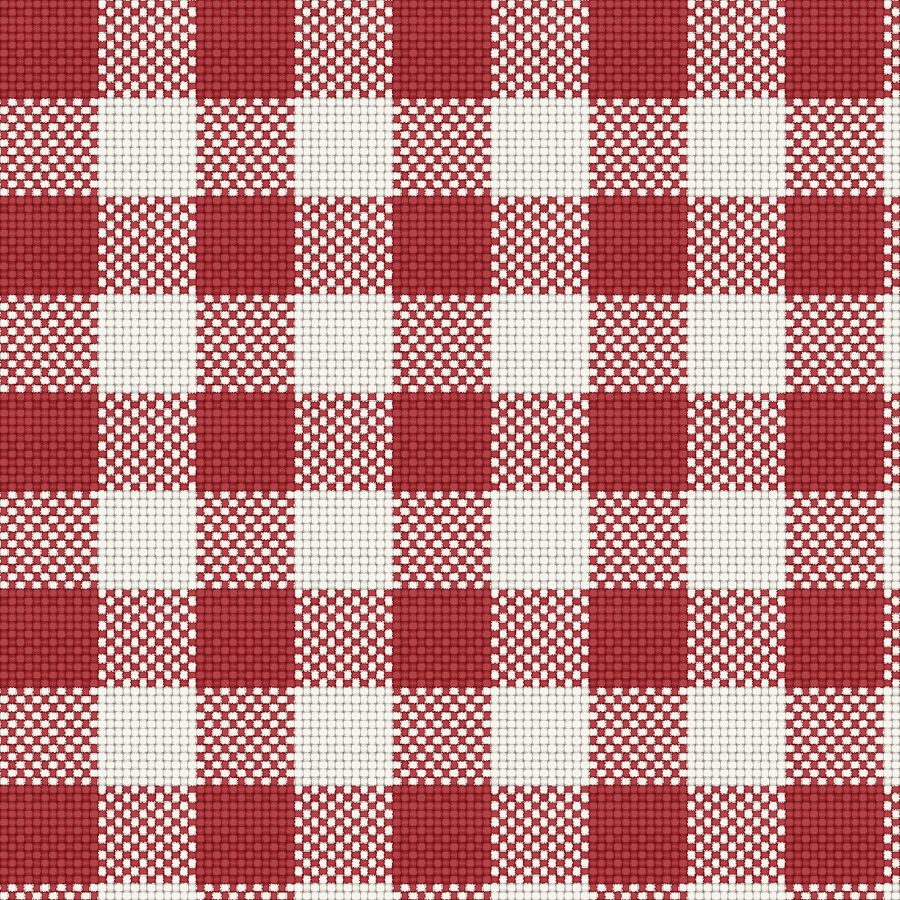
Gingham is a check rather than a plaid in everyday speech, and the reason is in the sett:
G12 F12. Twelve threads of colour, twelve of white, and then again. Nothing varies,
so nothing in the cloth is more important than anything else, and the eye reads it as a texture
rather than a pattern. It is woven yarn-dyed — the threads are coloured before
they go on the loom — in plain weave, where every weft thread passes over one
warp thread and under the next.
That plain weave is also why gingham looks like three colours when it is woven from two. Where blue warp crosses white weft, the surface shows half of each, and at any normal viewing distance the eye averages them into a paler blue. The solid blue squares are blue on blue, the white squares white on white, and the mid-tone squares are the crossing. A printed gingham has to add that third colour deliberately; a woven one gets it for nothing. The render above shows it: only two yarns went in.
The word came the long way round. Malay genggang means striped, and the cloth that
reached Europe under the name in the seventeenth century was striped, not checked. The check is
a later, largely Manchester development, and the sizes are still spoken of in inches of check:
1/16, 1/8, 1/4, 1 inch. Buffalo check is the same idea at a shout —
G40 F40, black and red, forty threads to a block — and is usually filed under
plaid because of its scale and its lumberjack associations, though structurally it is a gingham
that grew.
Plaid: the family name
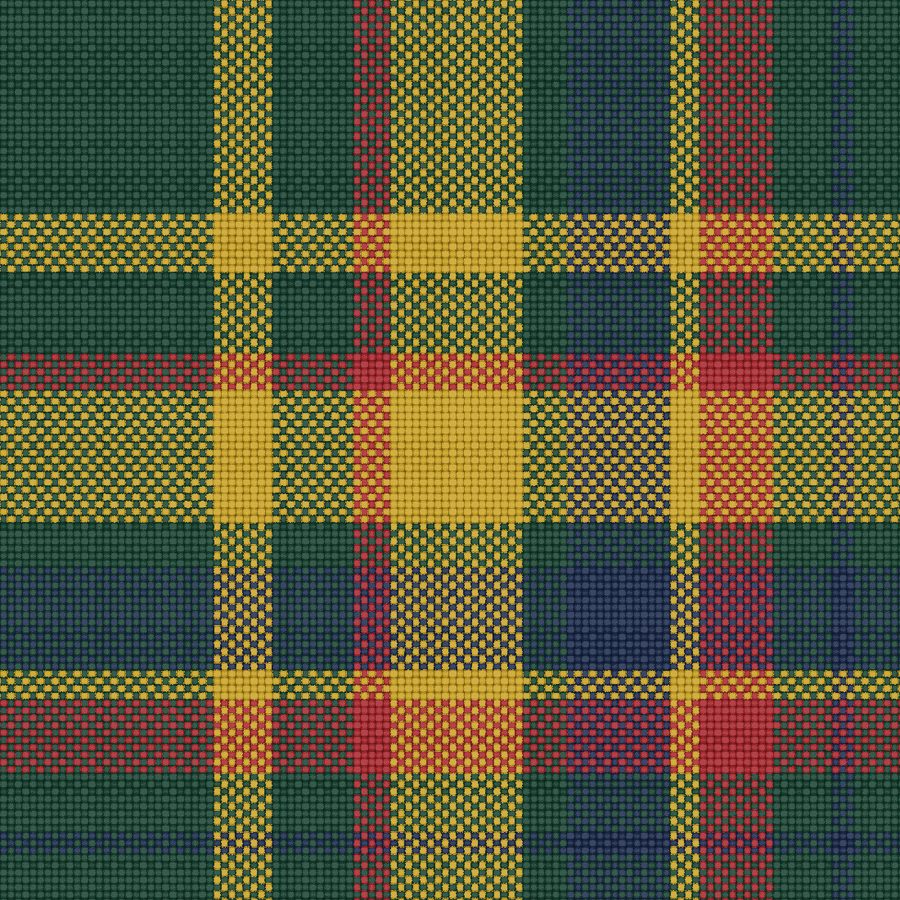
In the United States plaid means the pattern. In Scotland it never did. A plaid (from Gaelic plaide, blanket) is the garment: the long length of tartan cloth worn belted and thrown over the shoulder, which is also where the belted plaid and the modern fly plaid get their names. Americans saw the pattern on the garment and gave the pattern the garment’s name. Both uses are now standard; this page uses the American one, because that is the question people are asking.
As a pattern word, plaid covers every crossing-stripe cloth there is. It says nothing about the number of colours, the weave, or whether the sett mirrors. The madras above is a plaid with eleven stripes in four colours and no mirror line at all — the sequence runs straight through and repeats, which is what makes madras look loose and hand-made. Madras is Indian in origin, cotton, and historically woven from dyes that bled in the wash, so that the colours were expected to soften with each washing.
Most of the named checks in shirting and tailoring sit here too, and they sort themselves by weave and by stripe:
| Check | Sett | Weave | What makes it itself |
|---|---|---|---|
| Windowpane | G72 A4 | Plain | One thin line on a wide ground: the ground is the pattern |
| Tattersall | G22 A2 G22 B2 | Plain | Two thin lines in two colours, alternating |
| Buffalo check | G40 F40 | Plain | Gingham at a large scale, in black and red |
| Madras | 11 stripes, 4 colours | Plain | Asymmetric: no pivot, the sequence never mirrors |
| Shepherd’s check | G4 F4 | 2/2 twill | The smallest even check; the twill diagonal shows at the edges |
| Houndstooth | G8 F8 | 2/2 twill | The same even check, larger: the diagonal turns each square into a tooth |
| District check | G12 F12 | 2/2 twill | Gingham’s count in tartan’s weave, from the Scottish estates |
| Glen check | G12 F12 G12 F12 G4 F4 G4 F4 G4 F4 | 2/2 twill | Two check sizes in one sett, large blocks beside small |
| Prince of Wales | Glen check + A4 | 2/2 twill | A glen check with a coloured overcheck laid over it |
Notice that gingham, district check and the base of glen check share a count. The cloths look nothing alike. The difference is entirely the weave — plain against 2/2 twill — and the scale.
Tartan: a sett with a name
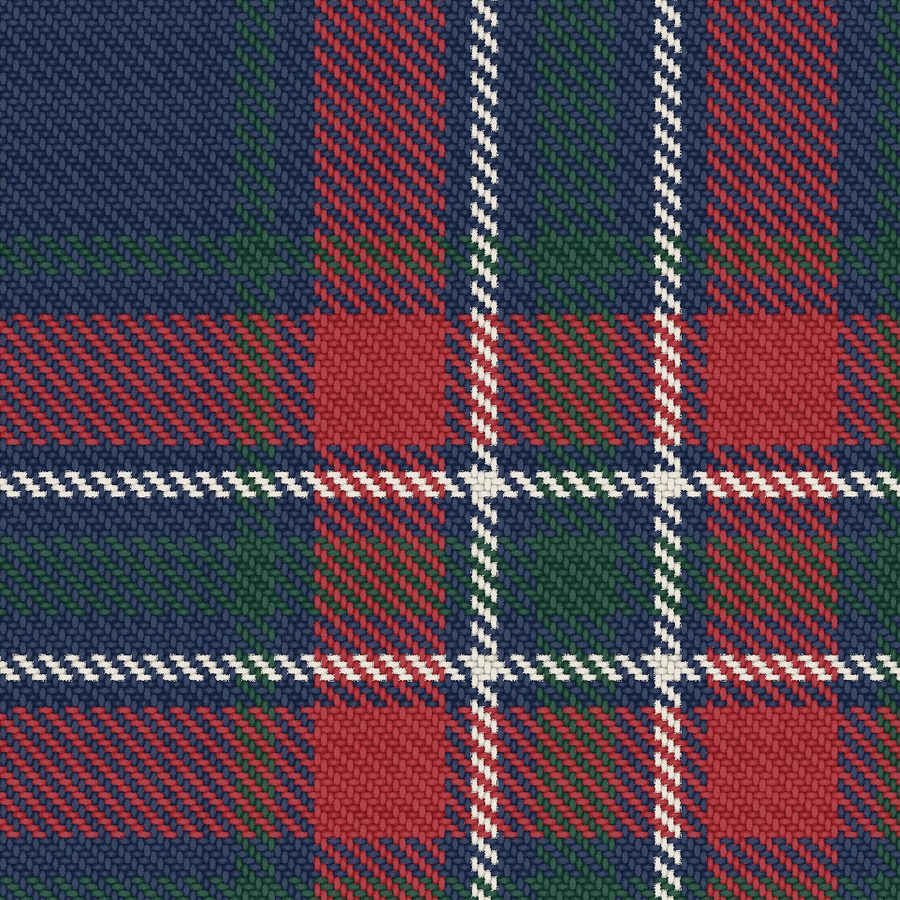
Tartan is not a look; it is a record. A tartan is a particular sett — the studio’s
example above is G36 F6 G6 A20 G4 B4 G6 F12 — that has been written down under a
name, so that a weaver anywhere can reproduce it thread for thread. In Scotland the records are
kept by the Scottish Register of Tartans, set up by Act of the Scottish Parliament
in 2008 and held at the National Records of Scotland; clan, family, district, regimental and
corporate tartans are all entered the same way, as a thread count and a set of colours.
Three things follow from that, and they are what the eye picks up as “tartan”:
- Symmetry. Almost every tartan sett is mirrored: the count is read to
the last stripe, then back again, so the first and last stripes are pivots and the pattern folds
on itself. The green
G36and the whiteF12above are the two pivots. A madras never does this; a gingham does it trivially. - Twill. Tartan is woven in 2/2 twill: each weft goes over two warps and under two, stepping one thread each row. That step draws the fine diagonal you can see inside every solid block of the render, running at 45 degrees. Plain weave has no diagonal. If a “tartan” has none, it is printed, or it is not a tartan.
- Colour count. Most setts use three to six colours, and where two cross the twill blends them into a mid-tone exactly as gingham’s plain weave does — which is why a four-colour tartan shows ten distinct tones, four solids and six crossings.
If you design a sett yourself, it is a plaid, or a tartan-style plaid. It becomes a tartan when it is recorded; and it should not borrow the name of a sett that already is. The studio will happily weave either.
Check, plaid or tartan: the word depends on where you are
Half the confusion is geography rather than cloth. In British English the everyday word for any crossing-stripe pattern is check — a checked shirt, a check suit — and tartan is kept for the Scottish setts. In American English the same everyday word is plaid, and check is kept for the small, even ones: gingham, buffalo check, shepherd’s check. So a London shop and a New York shop can sell the same shirt as a “check” and a “plaid”, and both are right.
A rough rule that works on both sides of the Atlantic: check suggests even, regular squares; plaid suggests stripes of different widths and colours; tartan means a named, recorded sett. If you are translating — the Arabic karohat, the Turkish kareli, the French carreaux — “check” is the closest single English word, and “plaid” the one American buyers will search for.
Tell them apart in five seconds
- Are all the stripes the same width, in two colours? Gingham (or buffalo check, if the blocks are big). Stop here.
- Is there a fine diagonal line inside the solid blocks? Twill. If the stripes also vary and mirror, you are looking at a tartan or a twill check (glen, houndstooth). No diagonal means plain weave: a plaid, a madras, a tattersall, a windowpane.
- Does the sequence mirror? Find the widest stripe and look either side of it. Mirrored and named: tartan. Mirrored and unnamed: a plaid you or someone designed. Running straight through with no pivot: madras or another asymmetric plaid.
- Does it have a name you can look up? Then it is a tartan, whatever it is woven in. Otherwise plaid is the honest word.
Weave one yourself: type a thread count, choose plain weave or 2/2 twill, and see the check drawn thread by thread — including the crossing tones no print can fake. Export it seamless and print-ready. Free to start, no credit card required.
Open the pattern generator →Frequently asked questions
What's the difference between gingham and plaid?
Gingham is one kind of plaid: two yarn colours, usually one colour and white, crossing in plain weave at equal widths so every check is the same size. Plaid is the whole family of crossing-stripe cloths, and most plaids use more colours, unequal stripe widths, or a twill weave. If the check is even, two-colour and small, it is gingham; if the stripes vary, it is a plaid of some other kind.
Is plaid the same as tartan?
In American usage, tartan is one kind of plaid: a plaid whose stripe sequence has a name and a history, almost always woven in 2/2 twill. In Scotland the word plaid means the garment, a length of tartan cloth worn over the shoulder, and the pattern is called tartan. So every tartan is a plaid, but a plaid is only a tartan when it is a recorded sett.
What's the difference between tartan and plaid?
A tartan is a specific, named stripe sequence, recorded in a register and woven in twill; a plaid is any crossing-stripe cloth, named or not. Design your own sett and it is a plaid; reproduce Black Watch thread for thread and it is a tartan.
Is gingham a type of plaid?
Yes. Gingham is the simplest plaid: crossing stripes of two colours at equal widths in plain weave. It is usually spoken of as a check rather than a plaid because its stripes never vary, but structurally it belongs to the same family.
What's the difference between check and plaid?
Mostly which side of the Atlantic you are on. British English calls any crossing-stripe pattern a check and keeps tartan for the Scottish setts; American English calls it plaid and keeps check for small, even patterns like gingham. As a rule of thumb, check suggests even squares and plaid suggests stripes of varied widths and colours.
Is Buffalo check a plaid or a tartan?
Buffalo check is a plaid, not a tartan. It is an even two-colour check, traditionally black and red, woven at a large scale, about 40 threads to a block. It has no recorded sett and no clan or district behind it, which is what would make it a tartan.
Why does gingham look like it has three colours when it is woven from two?
Where a coloured warp thread crosses a white weft, plain weave shows half of each, and the eye averages the two into a mid-tone. A blue and white gingham therefore reads as blue, white and a paler blue, and that third tone is not a dye but the crossing itself. A printed imitation has to add the third colour by hand.
Can I sell a pattern I call "tartan" if I designed it myself?
You can call your own original design tartan-style or a plaid inspired by tartan. Using the name of a specific registered clan tartan for a different design you created could mislead buyers, so keep the naming generic unless you are reproducing a public-domain historic sett accurately.
Does gingham need a special weave structure?
No. Gingham's check comes from plain weave alone, the simplest structure there is. Tartan and the twill checks (houndstooth, shepherd's, glen) need 2/2 twill for their diagonal; gingham does not.
Make one from a thread count
Each of these is a page of its own: what the cloth is, the thread count it is written in, a render straight from the engine, and a door into the studio on that cloth.
- Gingham pattern generator
- Buffalo check pattern generator
- Houndstooth pattern generator
- Shepherd’s check pattern generator
- Glen check pattern generator
- Prince of Wales check pattern generator
- District check pattern generator
- Windowpane check pattern generator
- Tattersall check pattern generator
- Tartan pattern generator
- Madras plaid pattern generator
- How to read a tartan thread count
- Plain weave, twill and the other structures
- What the free tool includes