Warp vs Weft: What They Are and Why They Matter
Guide · Updated 24 October 2026
In short: warp and weft are the two sets of threads in every woven fabric. The warp is the set of threads held under tension lengthwise on a loom before weaving starts. The weft is the thread that runs crosswise, woven over and under the warp. Plaid, denim and every other woven cloth are built from these two thread directions crossing each other.
The two directions
Picture a loom: a set of parallel threads is stretched top to bottom before weaving even begins — that's the warp. A single continuous thread is then passed back and forth horizontally through the warp, over one thread and under the next, building the fabric one row at a time — that's the weft.
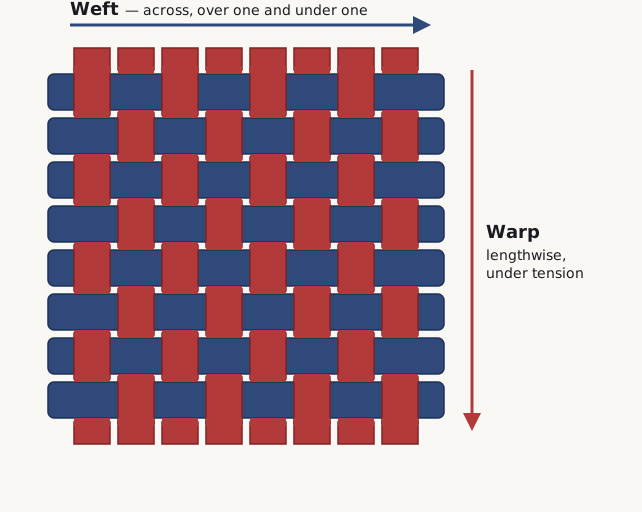
In a plaid or check design, the warp carries one colour sequence and the weft carries another (often the same sequence, for a symmetric "even sett" plaid). Where they cross, the two colours blend, which is what creates the small checks and diagonal lines you see in woven tartan — not flat colour blocks.
The two are not symmetrical jobs, and the loom is the reason. Every warp thread is threaded through a heddle — a wire or cord with an eye — and the heddles are carried on frames called shafts. Raising some shafts and leaving others down lifts part of the warp and opens a wedge-shaped gap across the loom: the shed. The weft is carried through that gap in one pass, and a comb called the reed then pushes the new pass firmly against the cloth already woven. Then the shafts change, a different set of warp threads lifts, and the next pass goes back the other way. Which shafts lift, in what order, is the weave structure.
One crossing pass of weft is called a pick, which is why weft density is measured in picks per inch or centimetre while warp density is measured in ends per inch — a single warp thread is an end. You will also meet the weft under other names: American mills usually call it the filling, and older British and weaving texts call it the woof. All three words mean the same thread.
How to remember which is which
The words themselves give it away once you have heard it once. Weft and left rhyme, and the weft is the one that travels left and right. Warp rhymes with harp, and a harp's strings run up and down under tension, exactly like a warp on the loom.
The etymology says the same thing and is worth thirty seconds, because it is the kind of fact that makes the pair stick. Weft comes from the Old English wefan, to weave — it is the thread that does the weaving. Warp comes from weorpan, to throw, because the warp is what was thrown or stretched onto the loom before any weaving happened. Woof, the old word for weft, shares the root with wefan too. So the warp is the thread that was put there, and the weft is the thread that does the work.
How to tell them apart in a piece of fabric
This is the question that matters when you have cloth in your hand rather than a diagram on a screen, and it has a reliable answer. Four tests, in the order of how much you can trust them:
- Find the selvedge. That is the firm, finished edge that does not fray, and it exists because the weft turns around there and goes back. So the selvedge always runs parallel to the warp. If the piece still has an edge like that, you are done — no other test is needed.
- Pull it both ways. The warp was held under tension for the whole weaving and comes off the loom straighter and tighter, so the warp direction almost always stretches less. Take a handful of cloth and pull gently along one direction and then the other: the stiffer direction is the warp.
- Count the threads. In most shirtings, poplins and suitings the warp is set more densely than the weft — more ends per centimetre than picks — so the finer, more crowded direction is usually the warp. This one is a tendency rather than a rule; plenty of cloths are set the other way round on purpose.
- Look at the yarn. Warp yarn has to survive thousands of heddle passes under tension, so it is typically the higher-twist, smoother, stronger of the two. Weft can afford to be softer, loftier and more decorative, which is why the weft is often where a fancy or textured yarn appears.
If the cloth has a diagonal twill line, that tells you the structure but not the direction on its own, so use the tests above rather than the twill.
Why the weave structure changes the look
How the weft passes over and under the warp is called the weave structure, and it changes how the crossing colours blend:
- Plain weave — over one, under one. Every crossing blends evenly, giving a flat, even texture. This is the simplest and most common structure for gingham and everyday checks.
- Twill weave — over one, under two (or similar), offset by one thread each row. This creates the diagonal line visible in flannel and traditional tartan, and shifts where each colour dominates at a crossing rather than blending evenly.
- Custom drafts — mills often use a specific draft (the exact over/under sequence) as part of a fabric's identity, distinct from the colour sett itself.
Two designs with an identical colour sett but different weave structures will look noticeably different once woven — which is why a colour-only design tool (one that lets you pick stripe colours but has no concept of weave structure) can't accurately preview what a mill will actually produce. There is a separate guide on plain, twill, basket and herringbone if you want the notation and what each one does.
What the crossing does to colour
Here is the part that surprises people, and it follows directly from warp and weft being two separate thread systems rather than a single flat surface. A woven colour is not the colour of a yarn. It is what the eye makes of two yarns alternating faster than it can resolve them.
Take a red warp crossing a navy weft. In plain weave — over one, under one — the surface alternates red, navy, red, navy at the highest frequency the cloth allows. At arm's length your eye cannot separate them and averages instead, so the crossing reads as a muddled purple that is in neither yarn. This is exactly why the crossing squares of a gingham are a genuine third colour rather than one of the two you chose, and it is why a red-and-navy check can come back from the mill looking muddy when it looked crisp on screen.
Now lengthen the floats. In a 2/2 twill each colour holds the surface for two threads before giving way, so the averaging is coarser and the two colours keep more of their own identity. In a 3/1 twill the face is three quarters warp and the weft barely registers on the front at all — which is how denim gives you a blue outside and a pale inside from one cloth. Same two yarns, same sett, three different fabrics.
The practical consequence for anyone designing a check: the number of colours you choose is not the number of colours that will appear. Every pair of crossing stripes creates a blend, so a six-colour sett produces far more than six visible tones, and the blends are what give woven tartan its depth. A flat vector drawing of the same sett has none of them.
Warp, weft and the grain of the cloth
If you sew, or if you are handing artwork to someone who will cut it, the two directions have names you will meet again. The warp direction is the lengthwise grain (often just "the straight grain"), running parallel to the selvedge. The weft direction is the crosswise grain. The 45° diagonal between them is the bias, and it is where nearly all of a woven fabric's stretch comes from — which is why a bias-cut skirt drapes and a straight-grain one hangs stiff.
Two things follow that matter for a printed or woven pattern. First, a garment pattern piece placed on the straight grain will hang along the warp, so any strong directional line in your design wants to be considered in that direction rather than whichever way the file happens to be oriented. Second, a check cut on the bias turns into diagonal lines, which is a deliberate and lovely effect but not the one you drew — so a plaid intended to read as squares needs to be cut on grain, and a yard of it matched at the seams.
"The warp and weft of…": the phrase outside the loom
Writers borrowed the pair long ago, and you will meet it far more often in a book review than on a mill floor: the warp and weft of a city, of a marriage, of everyday life. Used that way it means the underlying structure of something — the threads it is actually made of, as opposed to the pattern on top. The image works because of the difference between the two: the warp is what was set up first and holds everything in tension, and the weft is what runs through it day after day. Neither makes a cloth alone.
The older form is warp and woof, which is why it turns up in nineteenth-century prose and hymns; it means exactly the same thing. And if you arrived here from a crossword, the "crosswise thread" or "filling thread" in a clue is the weft — or woof, or filling, depending on how many letters the grid wants. The lengthwise one is always the warp; its single threads are ends.
Other languages keep the same pair and the same figure of speech. In Hindi and Urdu the warp is the tana and the weft the bana, and tana-bana means the make-up of a thing — a plan, a family, a town — exactly as warp and weft does in English. In Turkish the warp is çözgü and the weft atkı, the thrown one, which is the same idea as the Old English weft.
Why this matters when handing off a design to a mill
A mill needs three things to reproduce your design accurately: the warp colour sequence, the weft colour sequence, and the weave structure (draft) — plus yarn count, which determines the actual physical size of each stripe once woven. A design file that only specifies colours and pixel widths leaves the weave structure and real-world scale to guesswork.
Exporting with a true physical-size reference (for example, one repeat printed at exact centimetre scale on an A4 sheet) closes that gap — the mill can measure directly from the printout rather than converting pixels to yarn count themselves.
Try it live: The Plaid Studio's weave engine simulates real warp, weft, yarn count and weave structure — not just colour blocks — so the on-screen preview matches what a mill would actually produce. Export a colourway with a centimetre ruler, ready to hand off.
Open the pattern software →Frequently asked questions
What do warp and weft mean?
They are the two thread directions in any woven fabric. The warp is the set of threads stretched lengthwise on the loom and held under tension before weaving starts; the weft is the thread taken across them, over and under, one pass at a time. The words are Old English: warp from weorpan, to throw, for the threads thrown onto the loom first, and weft from wefan, to weave, for the thread that does the weaving.
Which way does the weft run?
Across the cloth, from selvedge to selvedge, at a right angle to the warp. It is the direction that runs left and right as the fabric comes off the loom — which is the easiest way to remember it, since weft and left rhyme.
How can I tell the warp from the weft in a finished fabric?
Find the selvedge — the finished edge that does not fray — and the warp runs parallel to it. With no selvedge to go by, pull the cloth gently in both directions: the warp was tensioned on the loom, so it is the direction that stretches less. As a third check, the warp is commonly the denser and higher-twist of the two yarns.
Is the weft the same as the woof or the filling?
Yes — three names for one thread. Filling is the usual term in American mills, woof is the older English word (from the same root as weave), and weft is the standard term in British and technical use.
What does "the warp and weft" of something mean?
Its underlying structure — the threads it is really made of. The phrase borrows the two thread systems of a woven cloth: the warp set up first and held in tension, the weft running through it. The older form, warp and woof, means the same.
What is a pick in weaving?
One crossing pass of the weft. Weft density is therefore counted in picks per inch or centimetre, while warp density is counted in ends per inch — a single warp thread being an end.
Which is stronger, warp or weft?
The warp, as a rule. It is held under constant tension throughout weaving and is dragged through a heddle on every pass, so it is spun stronger and with higher twist, and is often sized as well. The weft only has to be carried across, so it can afford to be softer, loftier or decorative — which is why a fancy or textured yarn usually appears in the weft.
What does "yarn count" mean?
Yarn count describes the thickness (or fineness) of a yarn — it directly affects how many threads fit per centimetre, and therefore the real-world physical size of each stripe in a woven pattern.
Is a "sett" the same in warp and weft?
Not always — an "even sett" uses the identical colour sequence in both directions (the most common approach for symmetric tartans), while an "uneven sett" uses a different sequence or scale in each direction for an asymmetric look.